
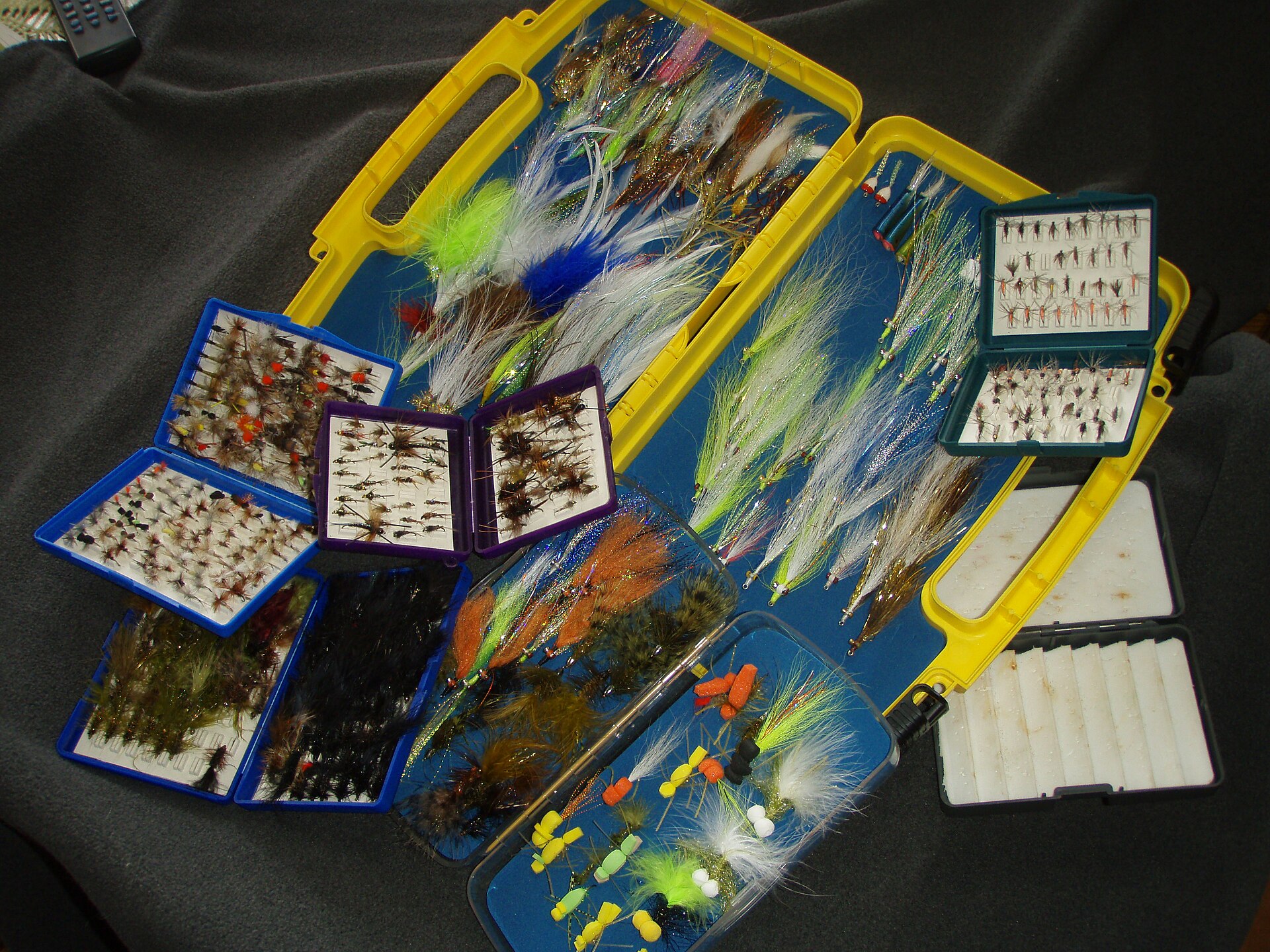
The right trout fly fishing flies come down to a short list: a few dries, a few nymphs, an emerger and a streamer or two. You choose among them by watching what the trout are doing, not by owning every pattern. For anglers who reach water by boat and fish unfamiliar margins, a compact, general-purpose box beats a large specialist one.
Which categories of trout flies do you actually need?
Four groups cover nearly everything you will meet: dry flies that sit on the surface, nymphs that fish below it, emergers that hang in the surface film, and streamers that imitate small fish or leeches. Everything else is a variation on one of these.
Fly makers and guides keep repeating the same point: there is a bewildering amount of choice, and much of it is redundant. One well-known Orvis instructor argues that a dozen patterns are enough to feel confident on trout streams anywhere in the world. A beginner-focused guide from New Zealand makes a similar case and suggests building depth in a few trusted patterns rather than buying a new pattern at random whenever one looks good in the shop.
Flies are also described by hook size, and the numbering runs backwards. The bigger the number, the smaller the hook. For river dries and nymphs, sizes 10 to 20 are the working range in that New Zealand guide, with 10 the large end and 20 the small end.
How do you match the fly to the water and the insects?
Start with what you can see. If fish are rising, look at how they take the food, because the style of the rise tells you which stage of the insect they want. If nothing is rising, the choice shifts to nymphs, or to a streamer in cold water.
The insect life cycle explains the logic. Nymphs live on the bottom, rise to the surface, hatch, dry their wings, drift, and later return as dead or dying adults called spinners. Each stage calls for a different fly:
- Emerging insects sit low in the film, so an emerger or low-riding dry is the match. Rises tend to look like small dimples.
- Freshly hatched adults drying their wings are taken more quickly and splashily, so a fly that floats on top suits that moment.
- Spent spinners cannot escape, so trout take them slowly, often with the head showing. A flush-floating dry fits.
Evening is often the best time to expect a hatch, though a hatch can come at other times depending on conditions. Keep watching the surface rather than assuming.
Season also steers the choice. In early spring, just after ice-out on a lake, trout can cruise aimlessly and ignore most offerings, and a slowly fished leech pattern is one answer to that problem. Once insects are active, the surface and the emerger become more useful.
Which patterns are worth carrying: Adams, Elk Hair Caddis, Pheasant Tail?
Several experienced writers independently land on the same short list, which is the best argument for carrying it.
The Adams. A Canadian outdoor writer describes it as the ultimate generalist whenever mayflies are hatching, and notes that it produces whenever insects are on the surface of a lake or stream. Its neutral shade appeals to trout in many conditions. His advice is to carry a wide range of sizes and keep the fly well coated in floatant, since a higher-riding fly is more effective. He fished it from tiny brook trout streams to big rivers to mountain lakes.
The Elk Hair Caddis. The Orvis author calls it a decent fly but notes that it can ride too high, and that larger trout may avoid a skittering caddis.
The Pheasant Tail. The New Zealand guide treats it as a go-to nymph because it is small and dark and resembles much of what trout eat in rivers. It pairs well with a hare and copper style nymph, the other pattern he trusts, and he suggests building each in several weights.
Add a foam fly as a searching pattern or hopper imitation, and a small terrestrial or beetle-style dry for days when fish sip something you cannot see. Those two choices come straight from the same Orvis list.
How should you build a compact box for travelling by boat?
Space and weight are tight aboard, and you will often fish water you have never seen. The goal is breadth without duplication. Think in terms of roles rather than pattern names.
- Dries: a general mayfly pattern such as the Adams, a caddis, a foam searching fly and a small terrestrial, each in two or three sizes.
- Emergers: a small olive and a paler cream or light-coloured option, since small olive mayflies hatch across a long season and cream mayflies across late spring to late summer.
- Nymphs: a Pheasant Tail, a hare and copper style fly, a tiny midge-larva pattern and a rubber-legged stonefly style, with beaded and unbeaded versions and a spread of weights.
- Streamers: a Woolly Bugger, plus one light and one dark baitfish-style fly.
- Backups: a leech pattern for cold water, and a worm or egg style fly for hard days or high water.
Counted up, this lands comfortably in a modest box rather than a drawer full of flies. Consider a couple of weighted and unweighted versions of your favourite nymph, because depth control often matters more than the pattern itself.
Store flies so hooks dry out and do not rust, and keep a few spares of whatever you lose most often.
Does presentation matter more than the pattern?
Often, yes. One Ontario river guide puts it bluntly: presenting the fly properly matters more than matching it to the hatch, and a poorly fished good fly loses to a well-fished poor one. If the fly drags or sits outside the strike zone, a perfect imitation will not catch anything.
He also notes that an odd, flashy fly can sometimes outfish a close imitation, but only when it moves at a natural pace. A bright fly zipping through a pool will be ignored. That is worth remembering when you are unsure what is hatching: a sensible attractor presented well is a valid choice.
For nymphs, the New Zealand guide makes a related point. Trout rarely lock on to one specific insect, so exact pattern becomes less important than how the fly is presented and at what depth.
In practice, that means adjusting weight, drift and position before you swap patterns. Change the fly after you have tried changing the presentation.
What can local shops and guides tell you, and how do tidal rivers differ?
When you arrive somewhere new by boat, a local fly shop or guide is the fastest way to learn what is on the water now. Ask which insects are active, which sizes are working, and whether fish are feeding on top or below. The Ontario guide argues that hiring a guide can be the most valuable investment in fly fishing, because knowing how and where to use a fly counts for as much as the fly.
Useful questions to bring:
- What stage of the hatch is on, and at what time of day?
- Are fish taking nymphs, emergers or adult dries?
- Which two or three patterns and sizes would you start with?
- Does the water need extra weight to get down?
On the difference between tidal rivers and freestone streams, the sources provided do not give specifics, so treat it as a local-knowledge question. Ask a local what the water does on the tide before you choose.
Frequently asked questions
How many trout flies should you carry when travelling?
A modest box built around roles is enough: a few dries, emergers, nymphs and one or two streamers. One Orvis writer says twelve well-chosen patterns can cover trout streams worldwide, so quantity matters less than variety of type and size.
Is the Adams a good all-round trout fly?
It is widely treated as a generalist, working whenever mayflies or other insects are on the surface. Carry several sizes and keep it well floated so it rides high.
Should you match the hatch exactly?
Not necessarily. One Ontario guide holds that presentation matters more than an exact match, and that a flashy fly fished at a natural pace can outperform a close imitation. Watch how fish rise to learn which stage of the insect they want.
What are emergers, and when do you use them?
Emergers imitate insects hatching in or just below the surface film. Use one when you see small dimpling rises, since trout often take hatching insects at that level.
Related reading
- How to Choose the Right Sailing Charter for You
- Long Range Expedition Yachts: What Range Really Means for Your Voyage
Sources
- Best Ontario trout flies used by Ontario’s top river guide (aperfectdrift.com, accessed 2026-11-14)
- Tom Rosenbauer’s 12 Essential Trout Flies (news.orvis.com, accessed 2026-11-14)
- What Trout Flies Do I need? (manictackleproject.com, accessed 2026-11-14)
- 7 must-have flies for trout anglers in the West—and how to … (outdoorcanada.ca, accessed 2026-11-14)
Photo: AssortedFlyBoxes, by Mike Cline, Public domain (Wikimedia Commons)