
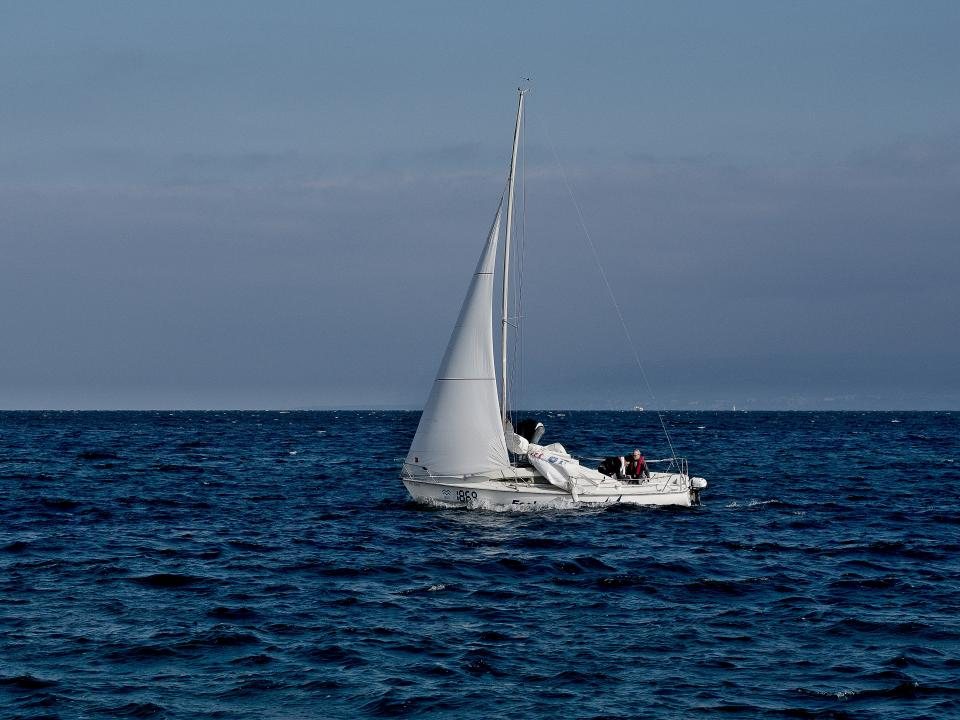
The best hour of any sailing day is the one spent doing nothing on the dock. Coffee in hand, boat still tied up, we watch. The water tells us more in twenty minutes than the forecast app did in twenty seconds, and it tells us about this exact bay, not the airport thirty miles inland where the official readings are taken. Reading the wind is a habit rather than a talent, and it starts with learning to see what is already in front of us.
Cat’s paws and the colour of the water
Look at a stretch of flat water on a light morning and you will see darker patches sliding across it. Those are cat’s paws: the footprint of a puff of wind pressing down on the surface and raising a field of tiny ripples that scatter the light differently. Where the water is glassy and pale, there is no wind at all. Where it is dark and textured, there is. The darker the patch, the stronger the puff inside it.
The trick is to watch them move. Cat’s paws travel with the wind, so their direction of drift tells us where the breeze is coming from long before we feel it on our cheek. On a summer morning in the Chesapeake Bay we often see them arriving from the south, a thin dark line at first, then a spreading stain of ripples, then the first stir in the burgee at the masthead. Anchored boats are the other giveaway. In calm water they swing to face the wind, and if half the fleet points one way and half the other, there is a current or a shift on the way and we take note.
What the clouds are lining up to say
The sky works on a longer clock than the water. Small puffy cumulus arranged in long parallel rows, what sailors call cloud streets, lie along the wind direction aloft, and on a settled day the surface breeze will run roughly parallel to them. High thin cirrus advancing from the west, the wisps often called mare’s tails, usually mean a front is on its way within a day or two and the wind will build and shift before it arrives. A hard grey line on the horizon with a clear gap of sky beneath it is a squall front, and the puff under it can double the wind in a minute.
Towering cumulus with flat dark bases in the afternoon are the thunderstorm builders. On the east coast of North America in July and August they rarely ambush anyone; they announce themselves by early afternoon and the sensible plan is to be back at the mooring before four. We have learned to trust that pattern over the Chesapeake more than any radar loop.
The sea breeze and its timetable
On a summer coast the wind is not random. The land heats faster than the sea, warm air rises over the shore, and cooler air is drawn in from the water to replace it. That is the sea breeze, and it keeps office hours. Most mornings begin glassy or with a faint land breeze drifting offshore. Somewhere between eleven and one the sea breeze fills in, reaches its peak of 10 to 15 knots by mid-afternoon, and fades again as the sun drops. By dusk the water is often calm once more.
This timetable is the beginner’s best friend. It means we can rig up in the calm of the morning, sail out on the first gentle puffs, enjoy the steady breeze of early afternoon, and be reaching home before it starts to gust. In places where a cool ocean meets hot land, the sea breeze can be far stronger. San Francisco Bay routinely sees 20 to 25 knots by mid-afternoon in summer, which is why local sailors talk of a boat being under-canvassed for the morning and over-canvassed by three.
What 15 knots actually feels like
Numbers are abstract until the boat heels. Fifteen knots is Force 4 on the Beaufort scale, a moderate breeze, and it is roughly the point where a pleasant sail becomes a proper one. On the water, whitecaps start to appear at about 10 knots and become frequent by 15. Small waves, half a metre or so, run with the wind and the tops break here and there. Loose hair lifts, a light jacket flaps, a paper chart needs a hand on it.
Ashore, the same wind makes flags stand out straight, moves small branches and whips dust across a car park. A 30-foot cruising boat under full sail in 15 knots will heel comfortably and move at hull speed, around 6 knots, and it feels lively rather than alarming. Add five knots more and the story changes: at 20 knots whitecaps are everywhere, spray comes aboard, and most cruising boats want a reef in the mainsail.
When a beginner should stay ashore
There is no shame in watching from the harbour wall. We have all done it, and the sailors who claim otherwise are not being honest. A few plain thresholds help. If the forecast sustained wind is above 15 knots, or gusts are predicted above 20, a first-year sailor in a small boat should leave it for another day. If the marine forecast carries a small craft advisory, the answer is already given. If the wind is blowing offshore, meaning from the land out to sea, remember that a light breeze at the dock hides a stronger one a mile out, and that any problem drifts you away from help rather than toward it.
- Glassy water with dark patches drifting steadily: light and building, a good morning to go.
- Frequent whitecaps in the harbour itself: 15 knots or more outside, stay put unless you are confident.
- Flags horizontal and a hiss in the rigging of moored boats: 20 knots, an afternoon for old hands only.
- A dark squall line under a clear band of sky: be tied up before it arrives.
Making a habit of it
None of this replaces a forecast. It simply grounds one. We check the numbers the night before, then spend the first twenty minutes of the morning matching them against the bay in front of us: the drift of the cat’s paws, the set of the anchored boats, the shape and height of the clouds, the flag on the yacht club roof. When the two agree, we go with confidence. When they disagree, the water is usually right, because the water is here and the forecast is a model of somewhere near here.
Over a season the reading becomes automatic. We find ourselves glancing at a lake from a car window and noting the wind, or watching the smoke from a chimney lean over a town we are only passing through. It is a small literacy, but it is the one that keeps a day on the water a pleasure rather than an ordeal, and it costs nothing more than the patience to sit on the dock a little longer than we planned.
Read next: Long Range Expedition Yachts: What Range Really Means for Your Voyage