
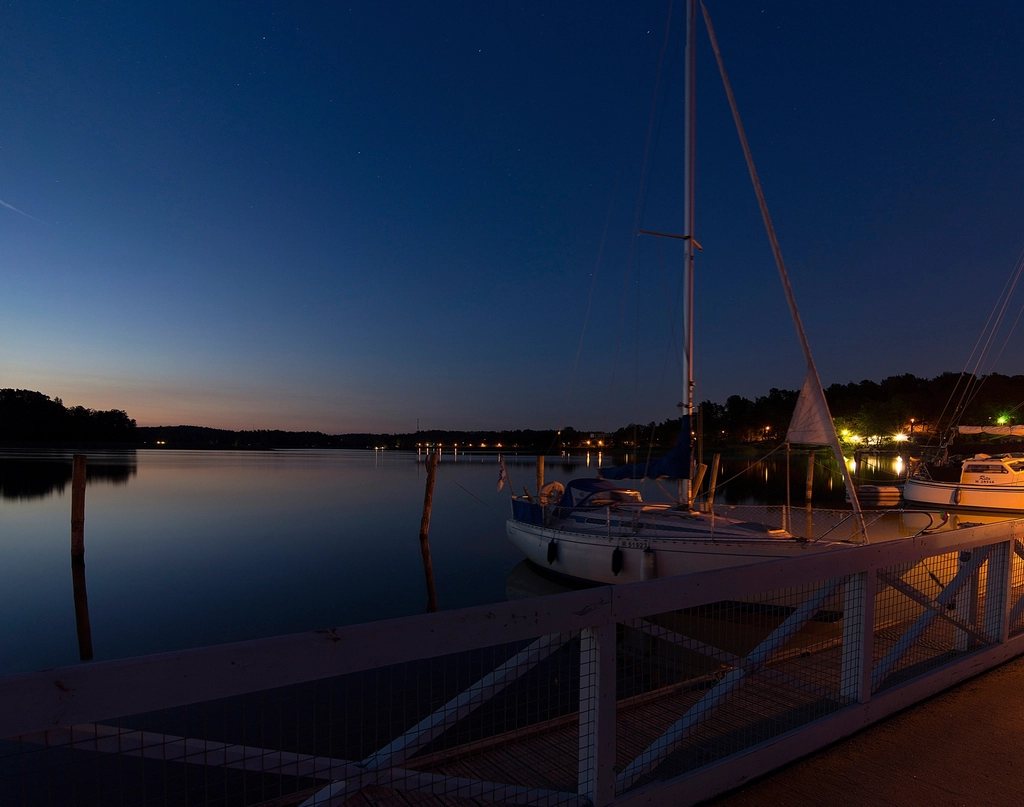
Every sailor who has crossed a stretch of open water has a story about the 0300 watch, and they tell it the same way years later: a little too carefully, as if the hours might still be listening. It is the middle of the night in the middle of nowhere. The rest of the crew are asleep below, the boat is moving through black water toward a horizon we cannot see, and for three hours the whole thing belongs to one person. We have stood that watch on a passage from the Chesapeake Bay to Bermuda, on the long haul down the Sea of Cortez, and on a short overnight across the Ionian, and it has never once felt ordinary.
How the night is divided
On a small boat with a crew of three or four, the night is usually cut into three-hour shifts. Someone takes 2100 to midnight, someone midnight to 0300, someone 0300 to 0600. The arithmetic is simple and the psychology is not. The first shift is still evening; there is a sunset in it, the smell of dinner, a last radio check. The last shift ends in daylight, and everyone knows that dawn will come to save them. The middle shift, and its cousin that begins at three, have neither. They start in darkness and end in darkness, and the body, which has its lowest temperature and its deepest urge to sleep at around four in the morning, would rather be anywhere else.
So the watch begins with a handover. The person coming off deck mutters the course, the wind, the last ship seen, the state of the sails, and goes below like a stone into a well. The person coming on clips a harness tether to the jackline, checks the compass, and sits down in the cockpit with the boat suddenly enormous and empty around them.
The first half hour, and the fear
Nobody admits it in port, but the first half hour is frightening. The eyes have not adjusted. Every sound in the rigging is a problem. The sea, which was a friendly blue expanse at lunchtime, is now an invisible thing that hisses past the hull a foot away. On a first offshore passage the mind produces a list: what if the wind rises, what if a ship comes, what if something breaks and no one hears me call. The tether on the harness is the only argument that answers all of it, and we hold onto that.
Then the eyes catch up. The horizon reappears, faintly, as the line where the stars stop. The compass light becomes enough to read by. The sounds sort themselves into the ordinary creak of a boat doing exactly what it did an hour ago. The fear does not vanish so much as thin out, like fog lifting, and what is left underneath it is a kind of concentration that we rarely get anywhere else in our lives.
Stars, and the sea that lights itself
Far from land the sky has no competition. On a moonless night the Milky Way is not a faint smear but a bright band with structure in it, dark lanes and knots of light, arching from one horizon to the other. Polaris sits at the height of our latitude above the northern horizon, about 37 degrees on the way to Bermuda, about 25 in the Sea of Cortez, and we check the course against it out of habit rather than need. Satellites cross every few minutes. Shooting stars come often enough that we stop counting.
The water answers. In warm seas the wake glows with bioluminescence, tiny plankton that flash when disturbed, so that the boat drags a pale green fire behind it and every wave that breaks against the bow throws sparks. Dolphins arriving at night are outlined in light, their whole bodies drawn in green as they weave under the bow. In the Sea of Cortez we have watched a school of fish scatter ahead of the boat like a burst of embers. Nobody who has seen it forgets it, and nobody who has not quite believes it.
Keeping watch, actually
There is work, and the work is what keeps the mind steady. Every ten or fifteen minutes we stand, turn a full circle, and look for lights. A white light low on the horizon is a ship’s masthead; when it grows a red or green beside it we know which way it is going. The rule of thumb is that a fast ship can come from below the horizon to alongside in about twenty minutes, so the circle is not optional. We check the sails, the course, the wind speed and the barometer, and write a line in the log every hour: time, position, heading, wind in knots, remarks.
Between rounds there is tea from a flask, a biscuit, a stretch of the legs along the side deck with one hand always on the boat. Some of us listen to music through one earphone, never two. Some talk to themselves. Most simply sit and watch the bow rise and fall and let the hours pass at their own pace, which is slow, and then, somewhere after four, suddenly fast.
Why it stays with us
Ask a sailor what they remember about a passage and they will not describe the arrival. They will describe the 0300 watch: the night the wind died and the sails slatted for two hours, the night a whale breathed alongside in the dark, the night they saw lightning flicker under a cloud fifty miles away and counted the minutes until the thunder never came. It is one of the few times in modern life when one person is fully responsible for other people’s lives, entirely alone, with nothing to do but pay attention.
That is the secret of it. The watch strips away everything except the boat, the sea and the sky, and gives them to us in the dark for three hours. The fear fades because there is nothing to feed it. The stars and the glowing wake become a private show. And when the eastern sky greys at last and the person coming on deck hands over a mug and asks how it went, we say “quiet”, because that is the only word that fits, and we mean something enormous by it.